Saturday, November 28, 2015

Thanksgiving Dinner Recipes? Try Food Art by Klimt, Keith Haring, & More

Thanksgiving Special: Seconds - Keith Haring. Images courtesy the artist

If you've ever wondered what it would look like if Damien Hirst stuffed a turkey, or how Salvador Dalí would serve a home-cooked meal, look no further than painter, illustrator, sculpture, digital artist, and, as of last Thanksgiving, food artist Hannah Rothstein. Even if that particular question has never wandered into your head, in her Thanksgiving Special works, the way she manipulates cranberry sauce, corn, and mashed potatoes to evoke the style of iconic artists like Keith Haring, Gustav Klimt, and Kara Walker—is impressive. 

Rothstein fell down the rabbit hole of fine art-inspired plating last year, mimicking Mondrian, Magritte, and Picasso using American comfort food. Her new series, fully named Thanksgiving Special: Seconds, expands the thought experiment to new mediums, most notably a replica of Hirst's The Physical Impossibility of Death in the Mind of Someone Living, with a turkey instead of a taxidermied shark.

"Most of these plates were made with the basic elements of the Thanksgiving meal—turkey, cranberry, stuffing, gravy, mashed potato, green beans, and corn," Rothstein says of her process. With her second-go at the concept, she got a little bit experimental: "I used a knife, dowel, and rag to, respectively, shape pieces, draw lines, and wipe up conniving stray marks. Some required extra bits of flair—gold paint for the Klimt, fabric and twine for the Christo."

Thanksgiving Special: Seconds - Damien Hirst

The most eyebrow raising of Rothstein's creations is, of course, the Hirst. Did she actually preserve a whole turkey for the sake of a holiday-themed art project? "As is often the case, the truth is unglamorous: This image was, for the most part, built out digitally," she reveals. "I didn't think my housemates would appreciate having the smell of formaldehyde wafting through the kitchen."

For those looking to recreate her work with your undoubtedly plentiful Thanksgiving leftovers, here is Rothstein's most vital advice. "Rule #1: Always have a clean rag on hand! You often end up with unplanned marks when plating, and wiping these off at the end makes a very noticiable difference." She honed her craft through trial and error, achieving really satisfying results with no formal culinary training. She continues, "Also, sketch out your design, or at least have a solid composition in mind, when you begin. Thoughtful foundations lead to better results." That's sound advice regardless of whether or not your art is edible.

Check out a few of Rothstein's creations below:

Thanksgiving Special: Seconds - Salvador Dali

Thanksgiving Special: Seconds - Gustav Klimt

Thanksgiving Special: Seconds - Kara Walker

Thanksgiving Special: Seconds - Christo and Jean-Claude

See the rest of Thanksgiving Special: Seconds on Hannah Rothstein's website. Limited edition Thanksgiving Special prints purchased from her store will contribute to the SF Marin Food Bank to help families who can't afford their own Thanksgiving meals. 

Related:

11 Artistic Uses for Your Thanksgiving Leftovers

How to Plate Your Food Like a Thanksgiving Artist

[Video Playlist] Fend Off That Food Coma with Our Thanksgiving YouTube Playlist

Here's How Designers Cut a Grid of Perfectly Isometric Food Cubes

Thursday, November 26, 2015

A Savage Journey into the Heart of Language Making

The Bureau of Linguistical Reality looking for words. Photo: Stephen Braitsch, courtesy the artists

The Bureau of Linguistical Reality began in 2014, well into the San Francisco drought. Founders Heidi Quante and Alicia Escott realized they were both experiencing Psychic Corpus Dissonance (PCD)—now defined as really enjoying un-seasonally warm weather while also being aware that the blue skies and warm sunshine are brought on by oncoming climate chaos—but on that particular day, didn’t yet have the right word for it. “We were at a loss for words for how to explain the dichotomy of our experience," they explain.

As it turns out, Alicia and Heidi aren't alone in not-having the exact words to express their emotional lives as they relate to the changing planet. The two women started throwing around neologisms such as "anthropocene" and "solastalgia"—the new name for our modern epoch, and the anxiety over climate change it reeks of, respectively—and were intrigued by how these terms were finding a new life in art circles. “We explored Linguistic Relativity: the idea that because we think in words, the institution of language directly shapes the way its speakers conceptualize their world,” Escott explains.

Quante and Escott bring people together to talk about the emotion and phenomena that we are experiencing as the temperatures and ecosystems change, and want to give participants of their talks the agency to coin their own, new words.

“I’ve been working on climate issues for 16 years, and behavior science shows that shifts happen through curiosity. We want people who don’t identify as activists to have a way into the conversation. So we started hosting field studies, bringing together scientists, artists, psychologists, poets and mothers, around a common theme. And we asked them to play at articulating their emotions, ideas and experiences of living in the world during this time of climate change.

We realized that by providing a space for people from diverse backgrounds to come together and brainstorm neologisms, we were facilitating people shaping their culture via language," Quante explains.  

Slow Ennuipocalypse_web.jpg

The Bureau of Linguistical Reality is taking their show on the road and will be in Paris during the UN Climate Talks, which begin this weekend. “I’ve participated in many of the climate talks, laws come and go, so regardless of if we come up with a binding agreement, we have an opportunity to shift cultures by having a new relationship with the climate conversation. By going to Paris we want to share a new approach and way of engaging diverse sectors of the society and the event while bringing people of diverse backgrounds together," they explain. 

Quante shared her observations of how people shift through the experience of attending one of their field studies: “Participants walk in as observers of creative culture. By the end of one of our sessions they have developed new language. Our hope is that we can inspire the people who participate in our project to shift their relationship to seeing themselves as being a part of changing culture."

If you won’t be in Paris for COP 21, you can follow what they're doing on Instagram: @thebureauoflinguisticalreality. 

Where to find The Bureau of Linguistical Reality in Paris:

  • ARTCOP 21, The Summit of Creatives,

  • November 26 & 27: Facilitating workshops at the Conference of the Youth on how to use art and culture to engage people on the climate change issue.

  • Place to B  November 29-December 10

  • Gaité Lyrique on December 6th

Click here to visit the Bureau of Linguistic Reality's website. 

Related:

Step Inside a Book Labyrinth Shaped Like Borges' Fingerprint

Cantoni And Crescenti Tear Down The Tower Of Babel With 40 Cell Phones

Words Become Monumental Works in the Hands of Idris Khan

Tuesday, November 24, 2015

Old Stock Photos Jolt Back to Life in These GIFs

A.L. Crego, via

The magical portraits in the Harry Potter-verse have nothing on the army of artists who flocked to revitalize old photos in this the Digital Public Library of America's "GIF IT UP" competition. In lieu of a magic wand, creatives from the world over used Photoshop and other software to reanimate ancient paintings, old logos, and photos of the long-dead. Sourcing material from public domain archives DPLA, DigitalNZTrove, and Europeana, artists can capture the creepiness of Victorian children and energy of ye olde illustrations, or juxtapose many eras into a mishmash of meme-worthy excitement. Each post on the GIF IT UP Tumblr includes information about the source material (lots of history buffs, you'll find), and an explanation of the artist's new vision.

"This year we received more than double the amount of entries we received last year," DPLA representative Kenny Whitebloom tells The Creators Project. Considering the fact that the GIF IT UP website includes a basic tutorial about how to make a GIF, the results are a healthy range from beginner to cold-blooded GIF master. However, with appearences from some of our favorites, like A.L. Crego, plus plenty of fresh talent, GIF IT UP 2015 has transformed the allure of old, free images into a hotbed of brand new work. Here are a few of our favorite creations:

http://gifitup2015.tumblr.com/post/133599039448/gif-it-up-2015-entry-by-dan-florence-from-kuna

http://gifitup2015.tumblr.com/post/133676127968/gif-it-up-2015-entry-by

http://gifitup2015.tumblr.com/post/133741796323/gif-it-up-2015-entry-by

http://gifitup2015.tumblr.com/post/133082744033/gif-it-up-2015-entry-from-juan-ibanez-in-sevilla

http://gifitup2015.tumblr.com/post/133338348508/gif-it-up-entry-by-devin-pascoe-from-atlanta

http://gifitup2015.tumblr.com/post/133678360928/gif-it-up-2015-entry-by-al-crego-from-a

http://gifitup2015.tumblr.com/post/133598914948/gif-it-up-2015-entry-by-dan-florence-from-kuna

http://gifitup2015.tumblr.com/post/133087596838/gif-it-up-2015-entry-by

http://gifitup2015.tumblr.com/post/133678898653/gif-it-up-2015-entry-by-al-crego-from-a
 
http://gifitup2015.tumblr.com/post/133034335658/gif-it-up-2015-entry-by-john-johnston-of-glasgow
 
http://gifitup2015.tumblr.com/post/133487699078/gif-it-up-2015-entry-by-michael-smith-from
 
http://gifitup2015.tumblr.com/post/131223339323/gif-it-up-2015-entry-from

See more on the GIF IT UP Tumblr page, and learn about the project on their website.

Related:

Meet the GIF Artist Turning His Dreams into Cinemagraphs

Lose Yourself in the Eerie GIFs of DarkAngelØne

Sculptural GIF Artist Sets Typography in Motion

Monday, November 23, 2015

A Ghost Visits Loved Ones in a Tender Animation

Screencaps via

When we die, we leave behind friends and loved ones that have to live through the pain of losing someone close to them. This an experience that Dutch filmmaker Michiel Wesselius chose to explore in his animated short, Jorka. The film explores the experience of mourners during the early stages of grieving and the logistical discourse that comes with planning a funeral wake.

The eight-minute stop-motion animation follows a ghost as he visits and observes the people closest to him shortly after he’s been killed. We arrive at each new character through a series of phone calls that link them together. Throughout the film no one speaks to each other directly face-to-face, every conversation is had over the phone. Maybe Wesselius is calling attention to the impact our smartphones have on the ways in which we connect with one another?

The film examines how each type of relationship a person has—between a mother and a son, two brothers, a friend, and a girlfriend—deals with death in its own way. The activity in the film is by no means extravagant; characters are shown doing banal activities like washing dishes, writing a letter, or playing outside. Yet, these little moments so vividly capture the human response to death.

The stiff yet lucid animation is set in a jagged and sharp world. Reminiscent of German Expressionist cinema, our protagonist walks through an off-center and slanted environment with a Nightmare Before Christmas kind of flair. It is cold. An environment filled in with blues, grays, blacks, and whites, setting a dark backdrop and melancholy tone for the story.

Watch Jorka below:

Jorka from il Luster on Vimeo.

!!! (Chk Chk Chk)'s New Music Video Is Basically Live-Action Futurama

Screencaps via

For film and television, space is far from the final frontier. Still, there’s room for flipping tropes on their head. Case in point: the music video for “Ooo” by Brooklyn’s punctuationally-nomenclated dance-punkers !!! (“Chk Chk Chk”), an intergalactic adventure straight out of an '80s prime time television warp drive. 

Directed by Too Many Cooks' surrealist wunderkind Casper Kelly, the video follows a part-jackass-part-hero space captain through his nebular journeys. Kelly explains to The Creators Project via email that the song's funky discotheque bumping and vocoded swoons translated into "a feeling of longing, and some instrumental elements that evoked science fiction."

The sci-fi kitsch is strong with this one, as the romantic, inter-humanoid-species womanizer finds himself constantly caught in the act by his companion’s partner, as well as blitzkrieging with other cel-shaded space ships, all in the pursuit of his one true love. Kelly’s familiar vintage aesthetic colors the pervasive slapstick humor, as do the screwball monster hands.  

"I was influenced by the Star Wars Cantina Bar and that Kirk/green woman romance in the original Star Trek," Kelly continues. "Star Trek is a sleek world and slightly stiff, while Star Wars is grittier—it was fun to try to collide that a bit.”

Watch "Ooo" below:

See more of Casper Kelly’s work here. !!! (Chk Chk Chk)’s album As If is available now from Warp.

Related:

What Architects Think Our Space Homes Will Look Like

Space Songs: An EP Made Entirely from NASA's Sound Library

Yukon Blonde's "Saturday Night" Is Fellini Meets David Bowie

Animated Music Video Imagines a World of Trippy Life Forms

Monday, November 16, 2015

Meet the Man Who Made Elvis’ Signature Gold Suit

All images by Tec Petaja for Freunde von Freuden

Freunde von Freunden is an independent and international publication documenting inspiring people from diverse creative and cultural backgrounds. Through online interviews, videos, mixtapes, and studio visits, from Istanbul to Seoul, FvF documents the lives of global creatives. In their latest 'Workplaces' segment, FVF’s Sarah Rowland interviews 82-year-old fashion designer Manuel Cuevas in his Nashville, Tennesse shop.  

Manuel Cuevas isn’t your typical clothing designer. He’s the man who hand-crafted Elvis’ signature gold lamé suit and made Johnny Cash into “The Man in Black,” and he’s sewn clothing for more superstars than he can count—Bob Dylan, James Dean, The Beatles, Frank Sinatra. He casually refers to Marilyn Monroe and Raquel Welch as “his girls,” and he’s responsible for influencing the notorious insignias of both The Rolling Stones and The Grateful Dead. He’s dressed presidents, athletes, dancers, and artists, and he created the wardrobes of more than 90 movies and 13 television shows. Over the years, he’s dressed everybody who was anybody. 

Born in the small town of Coalcomán, Mexico, Manuel’s true fascination with his art form began when he was only seven years old. His older brother, Adolfo, taught him how to sew, and he began making all of his own clothing. When he later moved to Los Angeles, he worked for several tailors, including Sy Devore, who was famously the tailor for The Rat Pack. Soon after, he moved to making costumes at Nudie’s famous western store in Hollywood, where he designed suits for people like Roy Rogers and the Lone Ranger. After working with Nudie’s for 14 years, he relocated to Nashville, Tennessee in the early 80s to continue his work in the music industry.

Today, record companies call on him to help create personas for their artists. He attributes this to the fact that’s he’s not afraid to create what artists need, instead of what they think they need. For more than 50 years, his designs have become iconic statement pieces that personify many musicians, actors, and stars. His Nashville shop is a true facet of the city’s cultural scene and, even more, a piece of American history. Each unique garment is made by hand in his downtown shop, where Manuel shows up for work every single day. 

Freunde von Freuden: What’s the process behind each piece? How do you start a new design?

Manuel Cuevas: I know how to do every damn thing you see in this shop. I design everything, I do the drawings by hand, I do the sewing and stones and leather. We start with something that’s like a drawing. I draw it out on paper first by hand, and then it becomes a sketch of what we embroider. On my new one I’m doing today, I have this skeleton sketch. See, here! The skeleton is smoking a little grass! So then we take the drawings, and we puncture them into the fabric. We draw the back part of the jacket, the sleeves, the front and the bottom all on paper. Then we perforate. When it’s perforated, it gets little speckles on the fabric. It’s done with a hammer. You’ve got to have imagination for this. Then we use the rhinestone machine. We embroider. We put it all together. Yes siree—it’s like magic! 

Read Sarah Rowland's entire interview for Freunde von Freunden here

Related:

Take a Studio Tour with Fa' Empel and Kirikoo Des in Berlin

'Friends of Friends' Captures the Beautiful Lives of Global Creatives

Take a Studio Tour with Mirror Artist Monir Shahroudy Farmanfarmaian

[Premiere] Mirrored Lights Dance on a Subterranean Stage in Continuum

C ● n ╋ n u u m from CinziaCampolese on Vimeo

Geometric light designs dance in robotic synchronization in Cinzia Campolese's latest work, Continuum. The project, presented at the roBot Festival in Bologna, is a precise feat of hypnosis. As shown in the accompanying 8-minute video, projections are cast onto the surface of a reflective panel—placed in the center of Continuum's subterranean setting—and images merge, reflect, and refract "to create a window between two parallel spaces." A thin layer of smoke augments these effects, while an original, tinny track by Trespur serves as the audio for the audio/visual. 

"Continuum represents the coexistence of duality," Campolese tells The Creators Project. "The combination of the 'two' creates a unique entity that reveals itself as a continuous representation within space... The aim is to create an environment where light is detected as a constant representation in space. The elements of projection touch and traverse the reflective panel, creating opposite aspects of two types of evolutions within the continuum."

Below, some stills from the captivating Continuum

All images courtesy of the artist

Find out more about Continuum on the project's page on Cinzia Campolese's website

Related: 

Stare into an Infinity Portal of Light Art

Watch a Light Art Installation Get Down in the Club

"X" Marks the Art in Minimalist Light Installation 'Convergence'

Thursday, November 12, 2015

Pseudomatisms Exhibition Finds Patterns in the Randomness

Rafael Lozano-Hemmer, Sphere Packing Beethoven, 2015. Pseudomatismos, MUAC, Mexico, 2015. Photo by: Antimodular Studio

Over the last 20 years, Mexican artist Rafael Lozano-Hemmer has created interactive videos, sound sculptures, and other intermedia work to pervert technologies like computerized surveillance, robotics, and the information networks of modern wired world. With Pseudomatisms, he gets his first comprehensive museum exhibition in his native country at the Museo Universitario de Arte Contemporáneo (MUAC).

Pseudomatisms finds Lozano-Hemmer steering clear of the Surrealist notion of “automatism”—the idea of random, spontaneous artistic expression. He parallels this with the computer’s inability to generate a truly random output. Lozano-Hemmer outputs these concepts in five new works, which are as varied as they are mesmerizing. It’s a means for him to show the flaws in how our minds and computers can can quickly analyze millions of data points and find repetitive patterns in the supposed randomness.

Rafael Lozano-Hemmer and Krzysztof Wodiczko, Zoom Pavillion, 2015. Pseudomatismos, MUAC, Mexico, 2015. Photo by: Antimodular Studio

For the work Babbage Nanopamphlets, he used nano-technology to print two million pamphlets in elemental gold, higher in purity than 24-karat gold. He released approximately 250,000 copies—each 150 atoms thick and biologically inert—into the exhibition space so that they float through the air, pushed along by the museum’s ventilation system and potentially inhaled by the public. The rest of the pamphlets are shown suspended in water in a small crystal vial with a magnetic stirrer, while a display shows electron microscope images of the pamphlets.

The text, engraved by the Cornell NanoScale facility onto the gold leaflets, is excerpted from the Ninth Bridgewater Treatise, written in 1837 by Charles Babbage, an English polymath. Babbage, “the father of the computer,” theorized that the atmosphere is a vast repository of everything that has ever been said, and that we might be able to “rewind” the movement of every molecule of air to recreate the voices of everyone who had spoken in the past.

Rafael Lozano-Hemmer, Airborne, 2015. Pseudomatismos, MUAC, Mexico, 2015. Photo by: Antimodular Studio

In Airborne, participants block the light of powerful floor-mounted projectors, casting their shadows on the wall in the process. These shadows are then tracked by computerized surveillance systems. Plumes of smoke are mapped onto the large wall, and within them are clouds of text generated from the live cables of news outlets such as Agencia EFE, Notimex, AlterNet, AP, and Reuters.

Zoom Pavilion, the first collaboration between Lozano-Hemmer and Krzysztof Wodiczko, is an interactive installation that features facial recognition algorithms and independent robotic cameras that zoom into amplify and abstract images of the public with up to 35x magnification. The fluid robotic camera movements highlight different participants to an animation that is constantly in flux.

Rafael Lozano-Hemmer, Babbage Nanopamphlets, 2014. Pseudomatismos, MUAC, Mexico, 2015. Photo by: Antimodular Studio

Lozano-Hemmer’s Sphere Packing: Beethoven and Schubert are two new entries in a series of 3D-printed pieces printed on different materials suspended from a small playback box that is hung from the space’s ceiling. The Beethoven and Schubert pieces are each designed to concentrate the composer’s entire musical oeuvre into a single dense multi-channel device. The size of each sphere is directly proportional to how prolific the composer was. Custom-made circuit boards allow for the simultaneous playback of thousands of separate sound channels.

With Pseudomatisms, Lozano-Hemmer hopes he can manage to disappoint technophiles and technophobes alike. Ironically, Lozano-Hemmer has made all 42 artworks open-source by publishing the source code, schematics, and associated files on a USB memory stick.

“We hope that our algorithms and methods will be reused by artists and programmers for their own projects,” he says. “This is done to highlight the fluid nature of creation in our digital world, where there is no such thing as as an artist alone, inspired in front of his canvas, but rather an ongoing dialog.”

Rafael Lozano-Hemmer, Sphere Packing Constellation, 2015. Pseudomatismos, MUAC, Mexico, 2015. Photo by: Antimodular Studio

Rafael Lozano-Hemmer, Eye Contact, 2006. Pseudomatismos, MUAC, Mexico, 2015. Photo by: Antimodular Studio

Rafael Lozano-Hemmer, Flatsun, 2011. Pseudomatismos, MUAC, Mexico, 2015. Photo by: Antimodular Studio

Pseudomatisms is on view at MUAC until March 27, 2016.

Related:

Bio-Foam, Kevlar and Carbon Fiber: A Mixed-Media Sculpture Show

8 Video Artists Tackle Collective Memory and Hidden Truths

Take an Audiovisual Journey into the Man/Machine Landscape

Wednesday, November 11, 2015

'The Royal Heart' Is a Transgender Fairy Tale for All

The Royal Heart has all the hallmarks of a classic fairy tale—a whimsical kingdom setting, the use of language like “thy” and “shall” and, of course, a princess protagonist—but there’s a twist. While it follows the traditional fairy tale format, it's actually a children’s book that focuses on transgender issues.

So it begins, “Once upon a time, in a far away land, lived a King and Queen...” Lyric is a young prince who is set to follow in his father’s footsteps and become king. He has a tough time growing up, worried that he’s not living as his true self and that he won’t be able to succeed to the throne. He runs away to find his grandmother’s spirit who helps him magically transform into a princess named Lyra. The princess returns to the castle and is accepted by her family, and ends up ruling the kingdom as the person she's always been on the inside.

A book of this nature is long overdue. Beyond Blue reports that up to 50% of trans people have attempted suicide at least once in their lives, most doing so in their adolescent years, with discrimination and exclusion being key factors in poor mental health. Targeted at ages 4-8, The Royal Heart aims to teach kids about acceptance, love, courage and family—whether they identify as trans or not.

Written by New York-based author Greg McGoon (and illustrated by freelance Disney artist J. Orr), The Royal Heart is the first in a collection of fairy tale books that will recognize LGBTQI characters and issues.

The Royal Heart is out now through Barnes & Noble and Amazon. You can find out more about the author here.

This article originally appeared on The Creators Project Australia. 

Via Co.Create

Related:

‘Tangerine’ Director Sean Baker Talks Infidelity, iPhones, and LA

Illustrator Draws Queer People of Color Doing Everyday Things

Apartamento Magazine Releases a Kid’s Book

'Second Skin' Sculptures #FreeTheNipple in an Artful Way


First one of my new second skin series

A photo posted by @esmaywagemans on


Instagram itself is quite clear about it: nudity is in no way allowed. Yet there’s still a lot of discussion going around this policy. A question that often arises, for example, is: Why are male nipples allowed while female ones aren’t?’ Last year, the #freethennipple movement unexpectedly took surface. Woman from all around the globe took to Instagram and Facebook, and shared selfies of their nude bodies. They still got censored, but the motivation was clear. Advocates of the movement accused the Western world in general (and the platform itself) of a sexist double-standard. Instagram subsequently defended their policy by stating they wanted their platform to be suited for all age groups (the app has a 12+ rating in the App Store). And children, so it seems—according to their general opinion—shouldn’t see any female nipples.

If it’s up to Esmay Wagemans, a fourth year at the Willem de Kooning Academy in Rotterdam, this will soon change. For her project Second Skin, she worked out a way to bypass Instagram’s nudity censorship. By using a self-developed special kind of latex, she actually managed to show her nipples without showing any skin.

I spoke to Wagemans about the creation of Second Skin, how people reacted on it, and why she thinks it’s important to revolt against any patronizing platform.

Second Skin (2015), Esmay Wagemans. All images courtesy to the artist
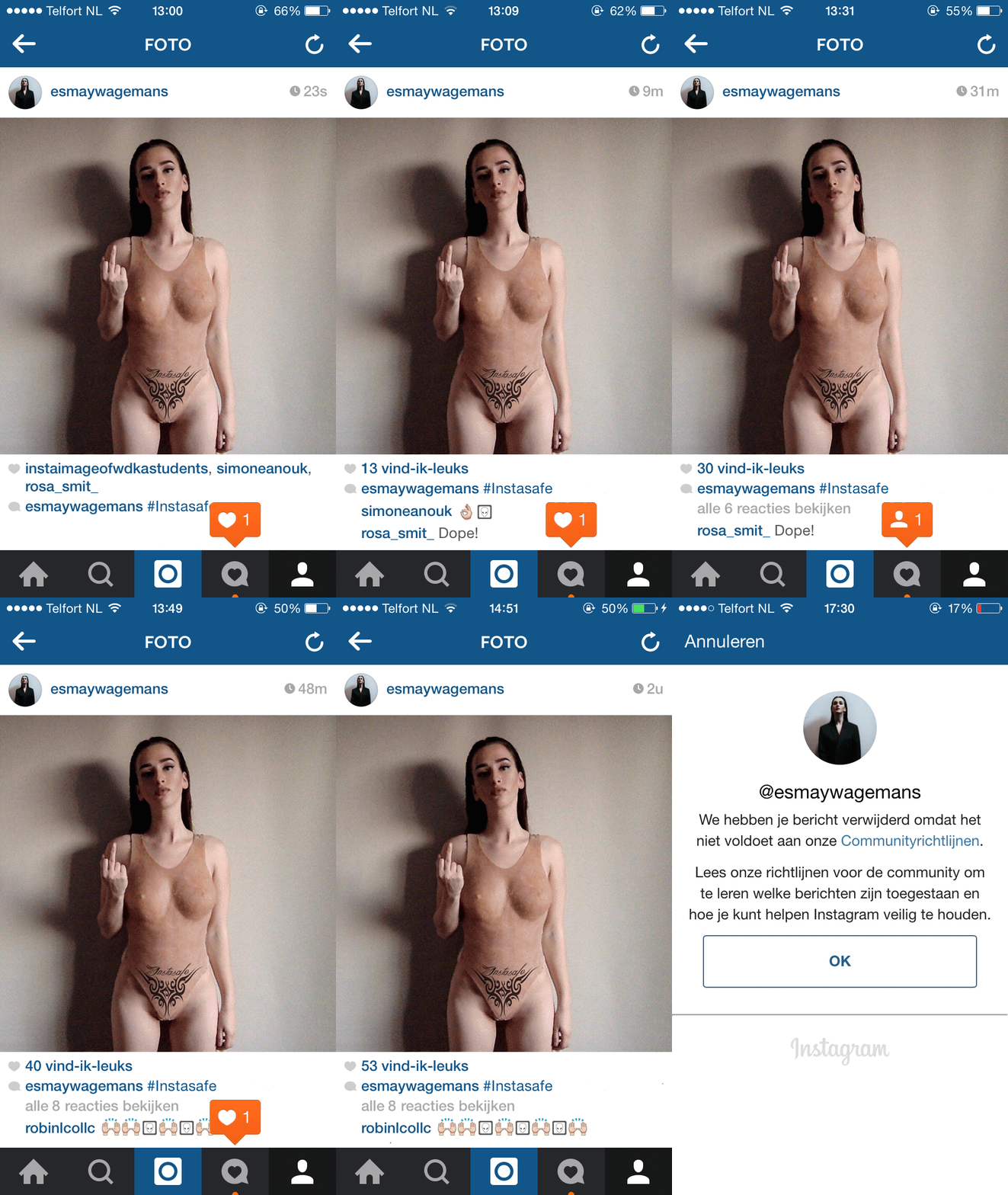
The Creators Project: Is your idea working out well thus far? Are all of your pictures still online?

Esmay Wagemans: Up until now, they actually are [still online]. There has been one picture taken offline though, but that wasn’t because of the nipples but because of a rebellious gesture towards Instagram. See, I put up my middle finger in it, and it was removed in less than half an hour’s time. I believe they have this questionable part in their guidelines somewhere, saying you should be “nice to each other,” hence why it was removed I think. A little while after, I uploaded a similar picture. This time again including nipples but without the middle finger, and it’s still there.

Is it your intention to get more women to wear Second Skin, or do you see it more as a one-off statement?

Well, initially I considered this only to be a conceptual art project. I was merely experimenting and seeing how far I could go without being removed. Only now I realized there’s also a certain fashion-aspect to it—it’s almost a piece of clothing. I really like the design of it myself because it is located exactly at the crossing line of nudity and non-nudity. If you look at it a little longer, you’ll eventually start asking yourself: is what I'm seeing nudity?

The only picture of Wagemans that got removed, most probably because of the middle finger

Why do you think it’s important to put your breasts on Instagram?

To me, Instagram is a very important platform to share my work as an artist. And I’m not going to change the essence of my work just because it would be too shocking for other people, or because it wouldn’t fit the social norms. Sure, I get that pornographic images shouldn’t be on it, but then again Instagram should focus on creating a different, less sexist and more refined nudity and censorship policy. Apart from all of this though, I do think Instagram’s strict nudity policy is sustaining the idea of a woman’s body as a sexual object.

How do you mean, "sustaining the idea of a female body as sexual object?" Don’t you think it’s a good thing children are restricted from seeing naked breasts?

I myself don’t think nudity should be such a taboo, because it feeds objectification. Look, if you’re not portraying breasts in an erotic or pornographic way, I think everyone should be able to see them, even children. By withholding those kinds of "normal" nudes from young teenagers, you’re still presenting the female body as something sexual. That’s simply not beneficial for anyone. Within that abstinence, the idea of the body starts being seen as something separate from the woman. It’s right there, where the objectification starts.

Follow Esmay Wagemans on Instagram to stay tuned about Second Skin.

By the way: we’re also on Instagram ourselves. Right here, to be precise.

A version of this article originally appeared on The Creators Project Netherlands. 

Related:

NSFW: Marilyn Minter and Betty Tompkins on Censorship, Art, and Being Embraced by Millennials

How Anonymous Tinder Nudes Became This Artist's Muses

Erotic Tapestries Put a New Spin on Nude Self-Shots

Wednesday, November 4, 2015

Colossal Wood Sculptures Track Death and Regeneration

Leonardo Drew working in his studio. / All images courtesy of the artist.

A massive hanging black sculpture made of wood, paper, rope, a raccoon skull, and dead bird feathers emerges in abstract expressionist sculptor Leonardo Drew’s seminal 1989 woodwork, Number 8. It draws from Drew’s personal history, referencing Jackson Pollock’s all-over drip paintings, and Piet Mondrian’s use of the grid to allude to dawn and decay. Drew’s upcoming solo show, Leonardo Drew at Pearl Lam Galleries' Pedder Building in Hong Kong, continues the Brooklyn-based artist career-long exploration of materiality and the cyclical nature of existence, and, for the first time, introduces color into the artist's work.

“I’m working all the time and one work assists the other work to realize themselves,” the Drew tells The Creators Project. “My base philosophy for the work is birth, life, death, and regeneration,” he adds. Number 9C and Number 14C have been oxidized or burnt in an effort to make it appear both fresh and weathered—abstractly signifying the various stages of life. “In Number 9C, I illustrated the process of disintegration. The sculpture looks like it is dissolving right before your eyes,” Drew explains.

Number 9C Wood and paint.

The use of wood also represents an evolution in Drew's practice over the last three decades. “Wood is a material I am interested in at the moment,” says the artist, whose work belongs to the collections of the Metropolitan Museum of Art and the Museum of Contemporary Art, Los Angeles. “Before wood it was cast paper, and before that, it was dust, and before dust, it was organic decaying material, there has been a number of different realizations as I have pushed my way through this art language,” he adds. Drew first started thinking about his art making practice as a young boy living in a public housing project complex in Bridgeport, Connecticut, where he spent time playing in a city landfill and making works out the objects he found.  

The mix media drawings, Number 19C, Number 20C, and Number 21C, and the introduction of pops of color in the new body of work, represent a return back to Drew’s earlier career as a painter. Number 21C is a gigantic drawing that’s on plastic done in cracked paint,” explains Drew. “It was a lot of fun doing it but at the same time, I was going back to an understanding of composition in a more traditional way. But as I am building on any material it’s with the idea that each thing has a time to it, and my work visually introduces that concept,” he says. Number 19C and Number 20C return to Drew’s earlier usage of cast paper, giving the drawings a sculptural nature.

“What you will see continuously in my work is a compression of time,” says Drew. “That compression falls in line with the layering process of a place like the Grand Canyon, from one layer to another, what you see is a line of history or life cycle and you see that represented consistently throughout my work.”

Number 10C Wood and paint.

Number 14C Wood, paint and screws.

Number 15C Wood, paint and screws.

Number 11C Wood and paint chips.

Number 18C Wood and paint.

Leonardo Drew solo exhibition opens November 13 and continues through December 31 at Pearl Lam Galleries' Pedder Building. For more information, click here.

Related:

A Sculpture of a Fallen Angel Is Stopping Beijing In Its Tracks

[Exclusive] Sound Art Alert: Kevin Beasley Plays His Sneaker Sculptures

Takeshi Murata Made An Animated Sculpture That Melts Into Itself